How RPM Hire Solved a Costly Safety Challenge with a 3D-Printed Innovation
Crash cushions are designed to absorb impact energy and protect both road workers and motorists when things go wrong. But like any safety-critical equipment, they only work if they’re maintained correctly. For Absorb M Crash Cushions, that means keeping two internal elements always filled with water. Get that wrong, and a unit that looks fine from the roadside may not perform as it should in an actual impact.
On large infrastructure projects, where dozens of units can be spread across kilometres of live traffic corridor, keeping every single one compliant is no small task. It’s exactly this challenge that led RPM Hire to develop a simple but effective new solution.
The Opportunity for Improvement
Absorb M units are designed to lose water over time through normal wear, minor damage, or leaks, which means regular checks are essential. Traditionally, that meant sending crews out to physically inspect each unit, visually confirming the water level was correct.
This was found to be a process that was becoming a significant cost and safety burden. Every inspection round required setting up dedicated traffic control just so a crew member could safely approach and check a single unit. Multiply that across a whole project’s worth of Absorb M units, and the costs in time, budget, and worker exposure to live traffic added up quickly.
It wasn’t just expensive. Every roadside stop put crews closer to moving traffic than necessary, and the constant start-stop of traffic control added to congestion and disruption for motorists and vehicles on site.
How RPM Provided a Solution
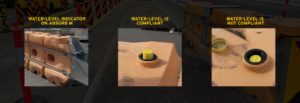
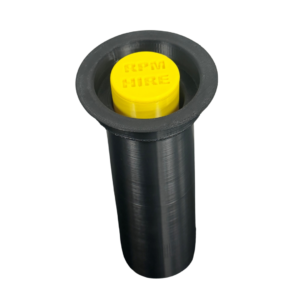
RPM Hire’s answer was to remove the need for a physical, up-close inspection altogether. Working in-house, the research and development team designed and manufactured a purpose-built Water-Level Indicator for the Absorb M system. This is a small, 3D-printed component that gives an instant, clear visual signal of whether the unit’s water-filled elements are correctly topped up.
Because the indicator is designed to be visible from a distance, crews no longer need to stop, park, and walk out to each unit. Instead, compliance checks can be done from a passing vehicle at normal driving speed or even remotely, using an RPM Hire CCTV Camera positioned on site. What used to require a dedicated inspection stop can now be confirmed in seconds, without anyone leaving the vehicle.
Developing the indicator in-house also meant RPM Hire could move quickly designing, prototyping, and testing iterations using 3D printing technology before finalising a solution that was durable enough for real-world roadside conditions and easy to read at a glance, in all weather and lighting conditions.
The Benefits
The impact of the Water-Level Indicator goes well beyond convenience. For customers running large-scale projects, it delivers value across safety, cost, and efficiency:
- Improved safety – crews no longer need to exit vehicles and approach units roadside for routine checks.
- Lower operational costs – dedicated traffic control is no longer required just to carry out a water-level inspection.
- Safer working distance – inspections can be completed well clear of live traffic lanes.
- Less disruption – fewer unnecessary lane closures and inspection stops means smoother traffic flow for motorists.
- Instant confidence – a clear, immediate visual confirms the unit is correctly filled and ready to perform if it’s ever needed.
For project teams managing compliance across dozens of units, that adds up to meaningfully less time, cost, and risk spent on what was previously a routine, but expensive task.
Innovation Driven by Customer Pain Points
The Water-Level Indicator is a good example of how RPM Hire approaches innovation to address real problems customers are facing on real projects. By listening closely to the challenges customers raised around Absorb M compliance and having the in-house design and 3D printing capability to act on that feedback quickly, RPM Hire was able to turn a costly operational pain point into a simple, practical fix.
It’s a small piece of equipment, but it reflects a bigger commitment: continuously refining RPM Hire’s product range so customers can improve safety, reduce costs, and keep projects and Australia’s roads moving.
Want to find out more about Absorb M Crash Cushions or the Water-Level Indicator? Get in touch with the RPM Hire team to see how it could work on your next project.